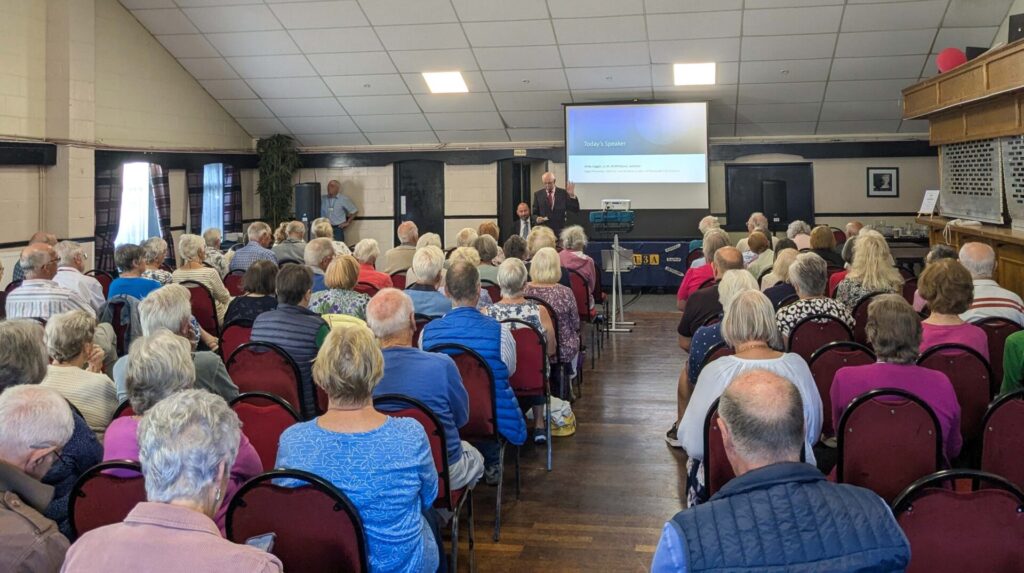
Our General Meetings are held at THE STADDY CLUB, STADDISCOMBE usually on the 3rd Friday of each month (any changes are notified to members). The doors open at 10 am, tea and coffee are available from 10.15 am - there is a £1 charge for a drink which is paid directly to The Staddy as they provide us with what we need. The meeting starts at 10.30 am with notices from the Chairman before the Speaker gives the talk. After the Speaker there are usually notices from Group Leaders, any other matters raised by members, and the meetings end by about 12.15 pm.
The inner doors will open at 10.00 for a 10.30 start. We ask you to remember to bring your Membership cards with you for scanning. Our Membership Secretary will be on hand to deal with any issues.
Forthcoming events
Disabled Facilities
We have allocated some disabled parking spaces at The Staddy for our General Meetings. Turn right on entering the car park, and facing the building you will find reserved parking spaces which will be available on a first come-first served basis. We ask that other members leave these spaces free for those who are Blue Badge Holders. There is ample parking for everyone, but we appreciate that the surface of the car park is not very flat and also rather stony, so we hope this will make it easier for some of our members to get to the building from their cars.
At the General Meetings we are also happy to help those disabled members who have difficulty walking or are hard of hearing. We always put out 2 or 3 rows of chairs on the right hand side of the room, with only 3/4 chairs in each row to enable people to get to a chair with ease. If you need help with this, or in finding a front seat if you are hard of hearing, please find a committee member and they will be pleased to help you.
Past Presentations by Guest Speakers
Note: We don't accept responsibility for the information provided or comments made by a guest speaker.
September 2026
Devon Legends and Folk Tales
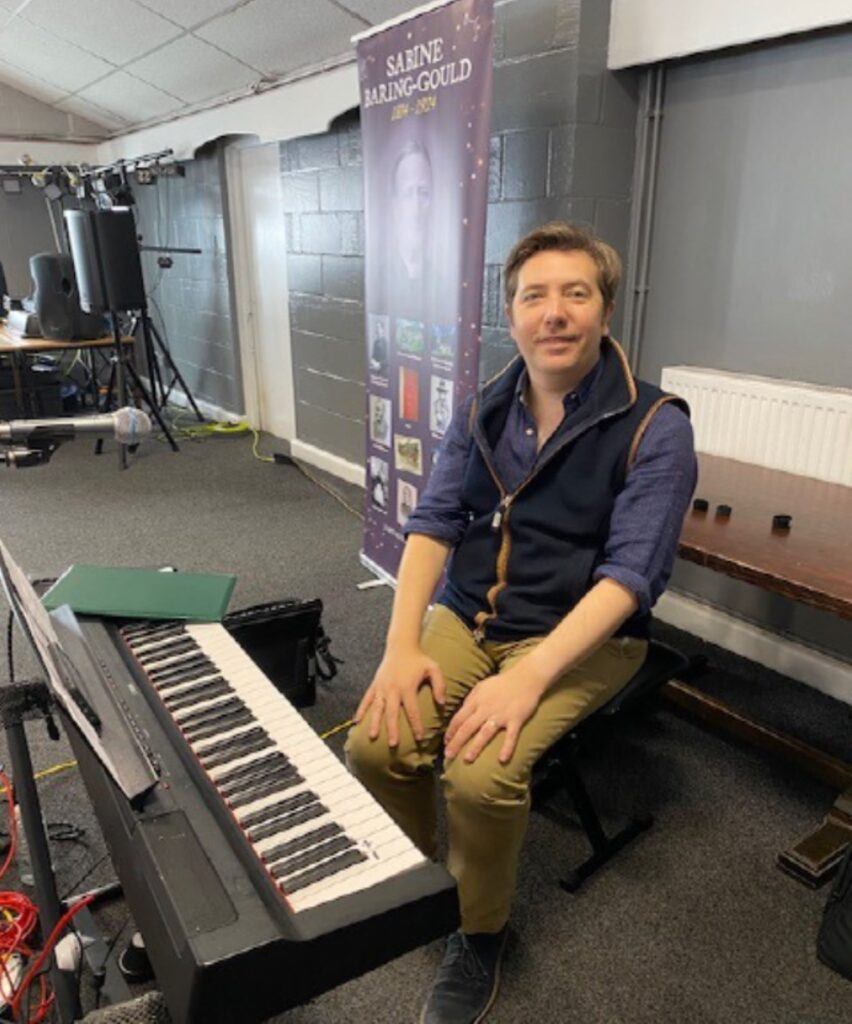
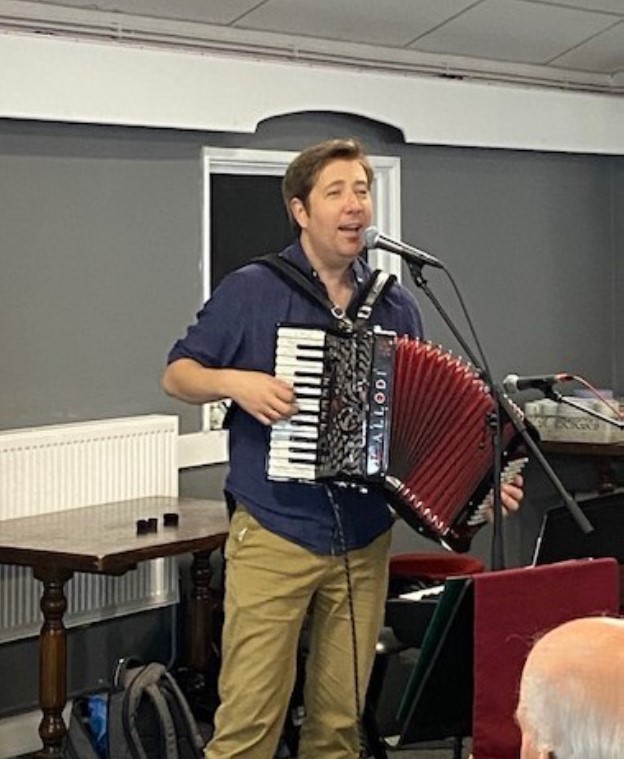
No country in the world does not have its own folk tales: so said Jim Causley, who came to our last general meeting and entertained us with his stories about Devon legends and folk tales. He also played and sang songs illustrating, in particular, the folk tales of Dartmoor.
Jim began his talk by telling us about the renowned polymath Sabine Baring-Gould whose family owned Lewtrenchard Manor in Devon. He was a historian with a particular interest in folk tales, legends and folk songs the latter of which he collected hundreds. He also wrote hymns and carols with perhaps the most famous being ‘Onward Christian Soldiers’.
Baring-Gould was a friend of George Bernard Shaw who was rather interested in Baring-Gould’s own family history where he had fallen for a 15 year old mill girl Grace Taylor. The relationship was not considered proper for a minister and teacher so she was sent away for three years to learn how to be a ‘lady’. When this was satisfactorily accomplished the couple were married and produced 15 children. GBS was so taken with this story he wrote a play ‘Pygmalion’ which was later made into the famous musical ‘My Fair Lady.’
Similarly another friend, Sir Arthur Conan Doyle, was attracted to the legend of a fierce black dog roaming the moor and so he created the ‘Hound of the Baskervilles’ for Sherlock Holmes’ adventures. Jim’s songs with musical accompaniment were greatly enjoyed by members who joined in the chorus where appropriate and many have asked for a return visit by Jim. I am sure we can arrange that next year so watch this space!
July 2026
National Open Gardens Scheme
Julia Tremlett
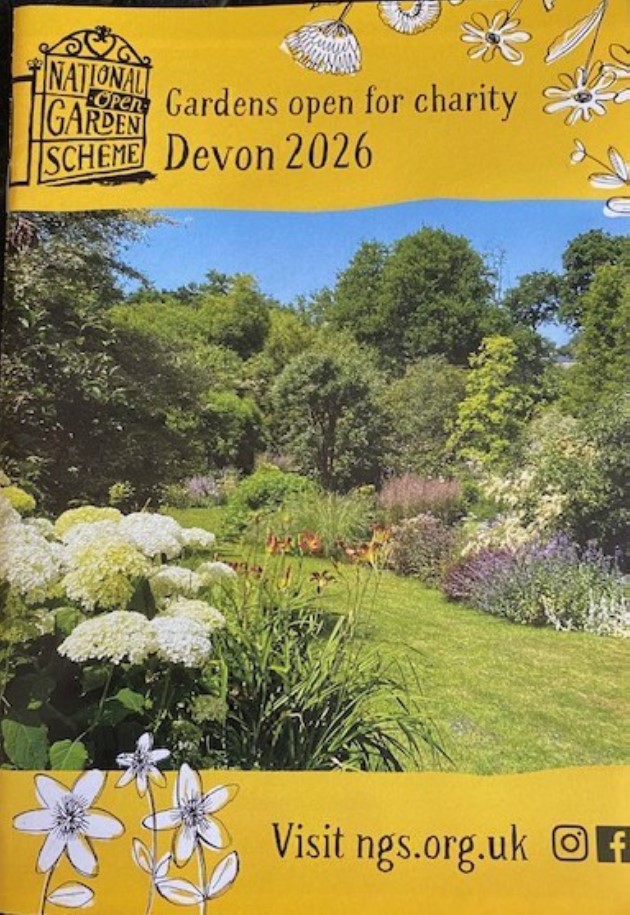
Julia Tremlett gave us an enlightening talk on the origins of the National Open Gardens Scheme.
In the 1850’s a Liverpool politician, William Rathbone, had a very sick wife for whom he hired a nurse to care for her. When she died Rathbone, with the help of his friend Florence Nightingale, developed a plan to build a training school for District Nurses where there was a dire need at that time and a century before the creation of the NHS.
Julia described the conditions the nurses worked with including no husband and therefore no family life. The system soon needed money as it became more successful and so in 1927 the decision was taken to open country gardens to the public for a small fee. The rest is, as they say, history. The scheme has grown exponentially and now is able to donate money annually to selected charities as well as giving so many garden lovers enjoyable days out.
June 2026
Dubious Cases From the Coroner's Court
Andy Lugger
After outlining the history and function of these courts Andy chose two famous cases where the findings were at least questionable.
The first was that of ‘God’s Banker’ an Italian financier, Roberto Calvi, with links to the Vatican. In 1982 his body was found hanging from Blackfriars’s bridge in London. The coroner’s verdict was death by suicide in spite of very obvious pointers to the impossibility of this conclusion.
In 1991 the famous QC George Carmen was successful in overturning this ruling and an open verdict was returned. The case is still open as to what actually happened.
T.E. Lawrence needed no introduction and his death in a motor cycle accident near his home in Dorset in 1935 is well recorded. Andy gave a brief account of his early life and adventures in the Middle East and went on to describe the proceedings in the court as to the three possible causes of his death, suicide, murder or accidental.
Members were asked for their opinions and a discussion followed with even more possibilities considered. One that he didn’t actually die but it was a cover up and he continued to be used for espionage purposes prior to WW2.
The majority of attendees however concluded that his death was accidental on the evidence given. In both cases we shall probably never be certain what happened but it was an enjoyable talk and Chris, our new Chair, thanked Andy for such a thought-provoking session.
May 2026
The History of the Mirror
Mike Haywood
Mike Haywood, who admits to an interest in the quirkiness of the human species, gave an intriguing talk on the history of the mirror.
For most of history, humans had no idea what they themselves actually looked like. It wasn’t until the last 200 years or so that mirrors as we now know them began to appear and satisfied what Mike described as our innate narcissism.
Some of the earliest ‘mirrors’ made of polished metals have been found on Devon and Cornwall archaeological digs and murals at Breage near to Helton depict a mermaid holding a mirror.
Artists in the past painted portraits to illustrate the uniqueness of their subject. As mirrors were developed it enabled artists like Rembrandt to paint self portraits.
In the 16th century mirrors became more common but only to the wealthy. France stole the method of using a thin layer of mercury on glass from the Venetians and the Hall of Mirrors at Versailles is a good example.
Silver use on glass began in the 19th century and started the growth of the mirror as we know it today.
Mike described how the vanity industry relies on mirrors and how most houses now own at least one mirror. Everywhere on today’s High Street the use of mirrors reflect our activities. We even step into a lift and see ourselves reflected therein.
However, we don’t always realise that what you see in a mirror is a ‘mirror’ image of what anyone else can see.
It was an amusing talk and David thanked Mike who is now working on the phenomena of left handedness. Perhaps he will come back and tell us his findings on that in the future.
April 2026
Farm to Fork
David Curry
David Curry, who is a retired ecologist, came to tell us of the importance of farming and how we can support not only the farming community but also the nation’s economy and our own health by supporting our farmers.
Currently we produce just 60per cent of our food and imports can be vulnerable to extreme climate conditions also by geopolitical events such as the current wars in Ukraine and the Middle East.
It is obvious, therefore, that it would be advantageous to eat more home grown produce and that would mean more seasonal ingredients. David went on to deplore food waste and criticised supermarkets for the exacting standards they impose on the producers which often result in good crops rejected because of size, shape or colour.
The organic food revolution is good for us all but as one audience member pointed out is often more expensive and therefore not in the reach of families with heavy commitments.
David spoke of the technical revolution in practices such as vertical farming which enables herbs and strawberries to have longer growing periods. Also satellite technology in tractors and agrivoltaics where land may be used for both farming and energy production by installing solar panels etc.
It was a thoughtful session and we were encouraged when shopping to look for the Union Jack or red tractor logo on our purchases. I am sure we could all be healthier if we took just some of David’s advice. After all as the saying goes ‘we are what we eat’.
March 2026
The Pinwill Sisters
Helen Wilson


In 1884 the Reverend Edmund Pinwill moved to the parish of Ermington with his wife Elizabeth and seven daughters. The church was in a state of near dereliction and following various appeals to wealthy neighbours the exterior was renovated and attention turned to the interior. With some foresight Elizabeth asked a local master woodcarver to teach three of her daughters his craft.
Helen Wilson, our speaker, said that this was not unusual at the time and showed us cuttings from the press with adverts for teachers of wood carving. It was however much more unusual that the three girls, Mary, Ethel and Violet, were able to establish a successful business as ecclesiastical woodcarvers.
Working with the architect Edmund Sedddon, the three girls transformed the interior of the church. In particular, pictures circulating of the beautifully carved pulpit drew attention and commissions resulting in the formation of the Rashleigh, Pinwill and Co ecclesiastical woodcarving company, which soon moved to St. Lawrence Yard in Plymouth. When Mary and Ethel subsequently moved away Violet took over as the sole proprietor and remained so until her death in 1957 at the age of 82.
There are 83 churches in Devon, 99 in Cornwall and 22 in other counties with known Pinwill carvings. Crantock church in North Cornwall is a particularly good example and there are also local ones to be found locally including Plymstock and Plympton and,of course, Ermington.
Helen has given more than 90 talks on the sisters’ work and given guided tours in Truro cathedral, Crantock and Ermington churches. Her book entitled ‘The Remarkable Pinwill Sisters’ is beautifully illustrated and is available to loan from all our local libraries should anyone be interested to learn more.
David thanked Helen for a most interesting and informative talk.
February 2026
The Box & Beryl Cook Exhibition
Abi Netcott

"The Box has become a local and national asset, thanks not only to support from Plymouth City Council and the Arts Council, but also from growing interest and support from the people of Plymouth and visitors to the City"
Abi Netcott is the Marketing and Development Manager at The Box. She came to talk to us at our last general meeting. Abi is a Plymothian who worked in London in the film industry but returned to her home city to help develop The Box which opened in 2020.
In spite of a rocky opening year, because of COVID, The Box has become a local and national asset, thanks not only to support from Plymouth City Council and the Arts Council, but also from growing interest and support from the people of Plymouth and visitors to the City.
The Beryl Cook exhibition ‘Pride and Joy’ is celebrating what would have been Beryl’s hundredth birthday. It has been a resounding success. On Thursday 19 February there were 3,600 visitors through the doors on the one day. There has been good national publicity, even mentioned on The One Show on TV, which should help the City in its bid to become City of Culture in 2027. Fingers crossed that we are successful.
Beryl’s paintings are raunchy and joyful. All her characters are having a lovely time. There is no misery here. She was a rather shy person and was inspired by such artists as Stanley Spencer, Edward Burra and even Ruben’s large ladies. Some of their works are also on display. Many of her paintings depict familiar places and scenes around Plymouth where Beryl lived. The Dolphin pub in the Barbican, Union Street’s nightlife, the bowling green on the Hoe and so on.
She was often brushed aside by the rather aloof art world but she didn’t care and became a self taught documenter of English life as she saw it in her home city. Some of her characters have been recreated by Theatre Royal technicians as larger than life characters and placed around the City becoming a popular walking trail. Look out for them. They will be there for a while.
The exhibition makes life look fun and jolly and considering the dreary wet winter we are witnessing it couldn’t have been timed better. Do visit and see for yourselves if you haven’t already been. It is free. The coffee in the restaurant is very good and I guarantee you will come away smiling.
January 2026
Fortress Britain 1940
Andrew Chatterton


Andrew Chatterton is a WW2 military historian and author. He came to talk to us about his book ‘ Fortress Britain 1940’ and how his research into the Home Front at that time revealed the secret layers of defence put in place to thwart any attempted invasion of Britain at that time.
In 1940 we were often portrayed as weak and underprepared against a seemingly mighty Nazi war machine. The TV series ‘Dad’s Army’, with amusing, rather bumbling elderly gentlemen, consolidated that view. However Andrew told of the strength, determination and incredible ingenuity - often very brutal in reality - that was secretly put in place to obstruct a possible invasion.
The concerted nationwide effort , much of which is now lost to time and to a post war narrative, was revealed in Andrew’s tale of unsung and highly secret prepara-tions and finally gives recognition to 1000’s of men, women and even children prepared to make the ultimate sacrifice for their country during some of its darkest hours.
December 2025
Christmas Meeting
Mulled wine, mince pies, group displays and group entertainment.


November 2025
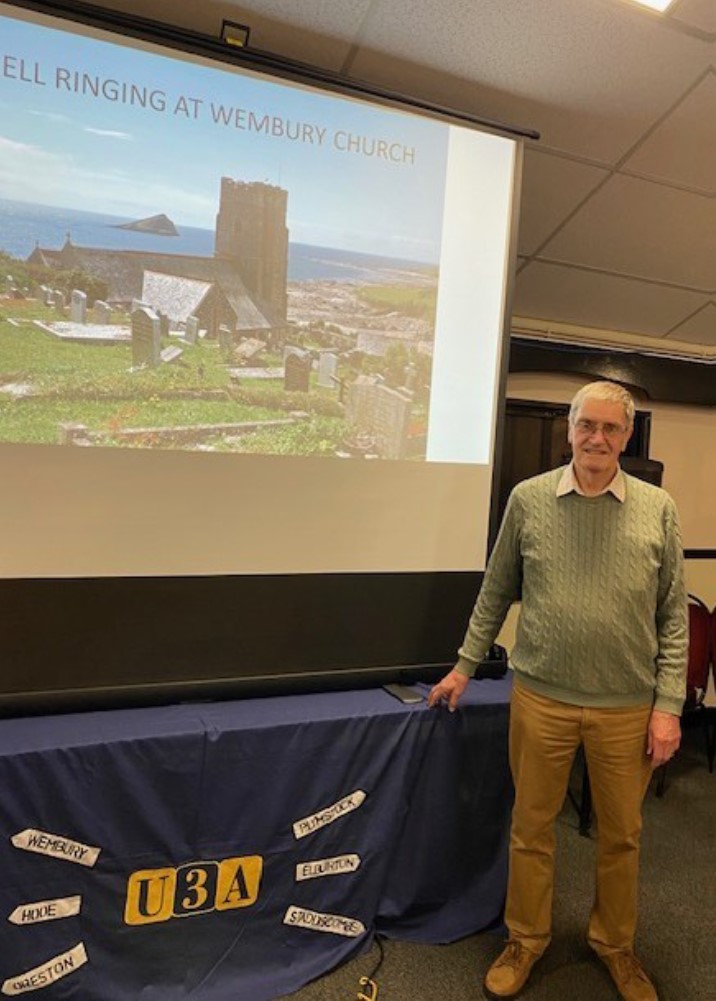
Wembury Bell Ringing
David Vaisey
David Vaisey, who came to talk to us at the last general meeting, has been ringing church bells for 56 years. He is now a leading ringer at St Werburgh’s church in its imposing position above Wembury bay. The tower of the church was built in 1420 and is a landmark for navigators and was a lookout point during both wars of the 20th century.
In 1909 the original three bells were augmented by a further two bells. Then in 1948 another was added in memory of the fallen villagers during WW2. So there is now a peal of six bells.
The bells are made of bronze and Wembury bells are lightweight compared to many. The heaviest in the country are the 12 at Liverpool’s Anglican Cathedral where they weigh over 16 tons.
During the recent renovation of Wembury’s bells all fittings were replaced and the bells taken to a foundry in Loughborough for recasting. Since the last treatment had been in 1909 this was in very serious need and the cost substantial. There followed
major fund raising and the money was eventually found. David showed us before and after pictures and it is hoped the bells are now safe for many years.
The history of bellringing goes back to the 1700’s. There are currently 40,000
ringers across the country following an appeal for volunteers prior to the Coronation in 2024. David trains prospective recruits and stresses the physical, mental and social benefits of the art.
We were all enlightened by the descriptions and suitably impressed by the complicated ‘Rounds’, ‘Methods’ and ‘Changes’ involved in various peals shown in the short video.
Chris, our Vice Chair thanked David and Sue Stoker, who is also a ringer at
Wembury and who assisted David. Several questions followed and illustrated the interest that David had aroused.
October 2025
Guide Dogs for the Blind
Carol Frost
Carol Frost brought her lovely guide dog, Tilly, and her equally lovely husband, Mike, to The Staddy for our General Meeting on Friday 17 October to tell us about how the Guide Dogs for the Blind Association helps those with sight problems to live as normal lives as possible.
Carol described how the dogs are carefully matched to each applicant’s needs. Puppies are born to selected parents and after eight weeks with their mum are sent to ‘puppy raisers’ who care for them for the next 15 to 18 months before their actual training starts.
Not every pup is deemed suitable for the job but Carol stressed that no healthy dog would be put down and those dogs who are considered unsuitable to be guide dogs or those who are retired are rehomed as pets with suitable families.
The dog and new owner have two weeks of intensive training after which they become partners and go home together. They have regular visits from an appointed trainer who is available for help and advice at all times throughout their life together.
It costs about £38,000 to provide and train each dog and all money has to be raised by donations and by volunteers. Labradors, Retrievers, German Shepherds and some Labradoodles are the breeds which are most suitable.
Carol told how Tilly had given her the confidence to lead a much fuller and active life and it was obvious that she was an integral part of the family. When she becomes older and has to retire Carol intends to keep Tilly as a family pet. Carol thanked us for allowing her to tell her story and was delighted with the voluntary donations which amounted to £155.26 deposited in the ‘bucket’ for the Guide Dogs for the Blind Association.

September 2025
Barbary Pirates
Ed James

Ed James came from Liskeard to tell us about his research into the devastating raids by Barbary pirates known as Corsairs around the coasts of Europe in the 16th and 17th Centuries. In particular their effect on the coastal villages of Cornwall and Devon.
The Corsairs travelled in their boats known as Zebeks which were fast and had shallow draught so were able to sail into smaller harbours. These raids were encouraged by their leaders in the Ottoman Empire who regarded non Muslims as infidels.
There is very little documentation of the horrors that ensued when men, women and children were captured and taken to places such as Algiers and sold into slavery. Those not deemed to be of use were murdered and villages burned.
Ed told of a letter sent to the Mayor of Plymouth from citizens of Looe asking for help after 80 mariners had been taken. Mounts Bay, St Keverne, Fowey and many other villages were all attacked. 200 were taken from Fowey on one raid and just 13 men and one woman escaped and were able to return.
Scotland, Yorkshire and even Iceland are now known to have been subjected to these horrors and in 1626 a group of 2000 women marched to London to seek help as their menfolk were afraid to go to sea and leave their families in case of a raid.
Was this the first female protest in British history?
Ed's research also illustrated what awaited the prisoners in North Africa. Men could be worked to death often as galley slaves and girls put into harems. It is generally agreed that over a million were taken in Europe and 20,000 of those from Britain and possibly a good half from Cornwall. It was a very dark, but relatively unknown, chapter in our history to which Ed opened our eyes.
August 2025
The Profumo Affair
Andy Lugger
Conspiracy theories are not a new phenomenon. This was well illustrated by Andy Lugger when he gave an account of the Profumo Affair at the last General Meeting.
Going back to the 1960s many members may recall the lurid stories about the hapless osteopath Stephen Ward, the Minister for War John Profumo and the Russian attaché Ivanov. Stir into that mix two good time girls Christine Keeler and Mandy Rice Davies and Harold Macmillan's Government was brought down.
In addition there were rumours of other aristocratic and celebrity names being involved in the scandal. As Andy pointed out, when the papers regarding the case are still locked away for another 30 years suspicions of a cover up by the establishment are aroused.
Andy is such a good speaker and was thanked by our Vice -Chair Chris. I am sure we shall hear more from him in the future.

July 2025
Devonshire Land Girls
Becks Pearson
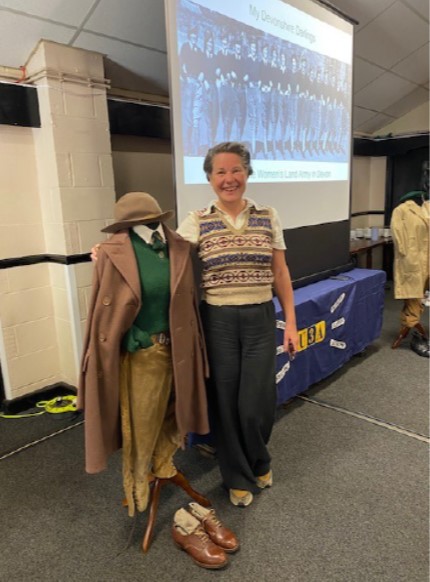
Devonshire Land Girls was the subject of a talk given by Becks Pearson. She opened by describing going to a local auction sale to buy a chest of drawers and ended up going home with a collection of Land Army uniform clothes! Intrigued by her purchase she could find very little information on the subject at Exeter records office but was happy to find a book written by Vita Sackville-West in 1944 on the subject which proved to be a mine of information.
The Land Army officially began during WW1 when a series of poor harvests, risky imports of wheat and farm workers fighting in the trenches necessitated action. Dame Meriel Talbot was asked to find women over 20 years of age suitable to work on the land. According to some there was some resistance in Devon to this proposition by farmers who were not convinced that girls would be capable of hard farm work. Back then there were 13,000, mostly small, farms in Devon and just 54 tractors.
The war ended and women returned to their previous lives until 1939 when Gertrude Denman, a well known supporter of women's rights and first President of the WI, was put in charge of recruiting 50,000 girls to be sent to work on farms throughout the country.
Two thirds of girls were recruited from cities and were trained for four weeks as some would have little knowledge of farming and animal husbandry. They were issued with a uniform samples of which Becks brought to display. A 'walking out ' and a 'working' one. They were paid 28 shillings for long seven days each week and depended on the farmer, their employer, for their accommodation and food.
Following the armistice in 1945 the Land Army was not disbanded until 1950 possibly as the men were slow to return, if indeed they did, from POW camps or the Far East or were in poor health. No medals or accolades were awarded to the girls for their service who even had to return their uniforms.
Much of the information and photos that Becks has accrued has been by tracking and talking to the few women who are still with us and/or their families. Many remained in Devon marrying into farming families and most had favourable memories of their time in the Devonshire Land Army.
June 2025
Putin, Trump & Ukraine
John Dobson
"The old world is dying and the new world struggles to be born. Now is the time of monsters".

Some of our members had previously enjoyed talks on Russia given by John Dobson and we were not disappointed when he returned to us with his latest talk entitled 'Putin, Trump and Ukraine'. John was a naval attaché posted to the British Embassy in Moscow and also a government advisor. As such he had an insider view of the machinations in dealing with Russia (or the Soviet Union as it was) and the rise of Putin from his early life in St Petersburg to his election as President in 2000.
John began his talk with the following quote:
"The old world is dying and the new world struggles to be born. Now is the time of monsters".
Although this could be ascribed to our present troubled times it was written in 1929 by Antonio Gramsci an Italian opposition leader who died in prison in 1937. The 'monsters' then were Mussolini, Hitler and Stalin. John believes the ' monsters' today to be Trump, Putin and Xi.
Putin invaded Ukraine out of a deep resentment blaming it for the collapse in 1991 of the Soviet Union and his belief that it belongs to Russia. He is seeking revenge through the brutal war he instigated believing he would meet no resistance as earlier in Crimea. However he underestimated the bravery and determination of Ukrainians to fight for their freedom and also of Western Powers finally realising the threat to Europe by Russia' s expansionist policies.
At home Putin still retains support from 75% of the population by keeping the country in a war economy and by 'rewarding' Russian mothers financially if they lose their sons in battle. To date over one million Russians have died or been severely wounded by the war.
John also mentioned the seeming influence he may have over Trump as the latter is reluctant to support Ukraine in her battle for survival even blaming them for the war and how the recent development of drones has challenged the tactics of warfare. Putin needs the war to stay in power whereas Trump needs peace to hold together his Maga supporters. Therefore John does not see an early resolution to this bloody conflict.
After John had answered several questions from a very appreciative audience our chairman thanked him for a most informative talk.