| Status: | Active, open to new members |
| Leader: | |
| Group email: | Astronomy group |
| When: | Monthly on Wednesday afternoons 2:00 pm Every 4th Wednesday of each month at 14.00 |
| Venue: | Silver Jubilee Hall Down Thomas |
We hold evening Star Gazing meetings on an ad hoc basis, based on weather conditions and the visible night sky.
This is a lively group of members keen to learn more about the stars and the universe in which we live. Members give short presentations on topics that they are interested in, such as the night sky, planets and galaxies to name a few. These short presentations generate lots of interesting discussion, which in turn determines the next meeting agenda.
Lots of information and suitable internet links are circulated and members can use this information for their own research.
We have now moved to Down Thomas Village Hall. We can now make more use of the excellent overhead projector, sound system and internet connection at the hall, by showing short videos at each meeting. This in turn generates very interesting discussions.
Recently, we have covered topics, from the birth of a star and the Earth, to the musings of Prof Cox, plus numerous theories about how the Universe began. At future meetings we will be looking at different moons in the Solar System and examining local nebulas. We have already discussed the beautiful Butterfly Nebula shown below:

Relevant information is also circulated around the group during the month so members can keep up to date with astronomical events as they occur.
If you are interested in astronomy in a general way, then please do come along to our meeting and enjoy learning about the universe in which we live.
April 2026
At the Astronomy group meeting in April, we discussed Artemis 2 and Elon Musk’s ideas about landing on the Moon.
From an Astronomy point of view, we looked at Comet R3 PanSTARRS, and watched short videos of the planet Neptune, Planet 9 and the Sun’s Heliosphere.
We then had a practical demonstration to show the distance between planets in our solar system, see the photo below.
Finally, we listened to a video by Roger Penrose explaining Space!!

March 2026
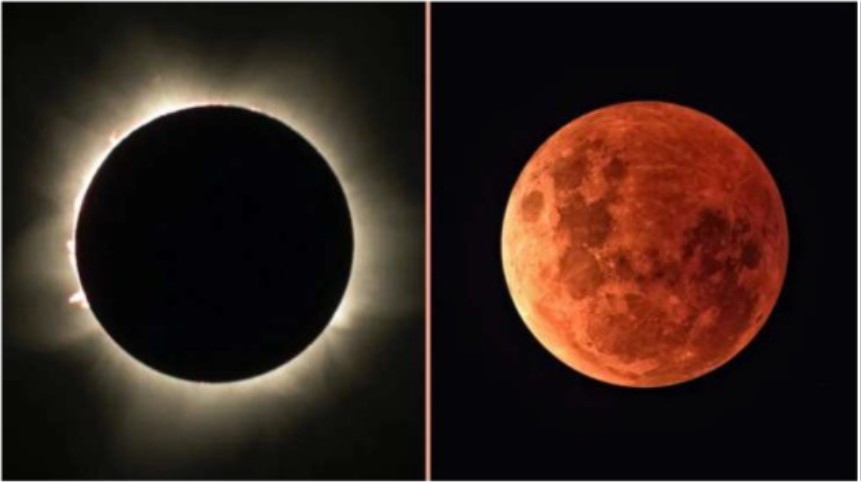
Why solar and lunar eclipses come in pairs.
Eclipses don't happen at random — they arrive in pairs, on schedule, and 2026 brings two spectacular seasons to prove it.
There are typically two eclipse seasons each calendar year. Between 17 February and 3 March 2026, the first of two eclipse seasons in 2026 will produce two eclipses separated by exactly two weeks: an annular solar eclipse followed by a total lunar eclipse. An eclipse season is a period of 31 to 37 days, during which eclipses become possible. These seasons occur about every 173 days, or roughly twice per year — and every solar eclipse and every lunar eclipse you've ever heard about has taken place within one.
It began on Tuesday 17 February 2026, with an annular solar eclipse, during which the Moon will cover 96% of the Sun to leave a slim "ring of fire" for up to two minutes and 20 seconds. However, it could be seen only from a small region of Antarctica, with a partial eclipse visible across Antarctica and parts of south-eastern Africa and South America. Exactly 14 days later, on Tuesday 3 March 2026, the same eclipse season produces a total lunar eclipse, with the Moon spending 58 minutes and 18 seconds fully inside Earth's dark umbral shadow. Those in East Asia, Australia, the Pacific and western North America will get the best views of the Moon, which takes on a reddish-coppery hue during totality.
The second and final eclipse season of 2026 is in August and is arguably the more dramatic one because it includes something not seen on Earth since 8 April 2024 — a total solar eclipse.
The eclipse season begins and peaks on Wednesday 12 August 2026 with a total solar eclipse. On that day, the Moon will completely cover the Sun for several minutes along a narrow path of totality that sweeps across Greenland, Iceland, and northern Spain. A deep partial solar eclipse will be visible across much of Europe, North Africa and the North Atlantic. Just over two weeks later, on Wednesday 28 August 2026, the same eclipse season produces a partial lunar eclipse.
Although less visually dramatic than a total lunar eclipse — a “Blood Moon” — the event will still see Earth's shadow move across a significant portion of the Moon's surface, a special sight in itself. Observers across North America, South America, Europe and Africa will be well placed to watch the Moon darken as it moves into the umbra.
Why not find out more about our Universe and come to the Astronomy group meeting held at 14:00 on the fourth Wednesday of each month at Down Thomas Village hall.